


 Send Inquiry
Calcium Carbonate for Cables
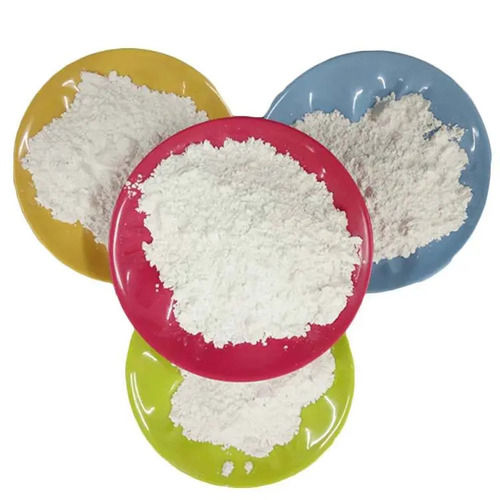

Calcium Carbonate for Cables Specification
- Form
- Powder
- Usage & Applications
- Used as a filler in cable manufacturing to enhance strength, stability, insulation, and reduce production cost
- Application
- PVC Cables, Power Cables, Electronic Wires, Cable Insulation & Sheathing
- Surface Finish
- Fine, smooth powder
- Melting Point
- 825C (Decomposes)
- Purity(%)
- 95% - 98%
- Water Absorption
- Very Low
- Hardness (%)
- Not specified, Mohs hardness: 3
- Density
- 2.9 Gram per cubic centimeter(g/cm3)
- Chemical Composition
- Calcium Carbonate (CaCO3)
- Product Type
- Industrial Mineral Filler
- Shape
- Powder
- Porosity
- Low
- Dimensional Stability
- High, enhances dimensional stability in cable insulation
- Strength
- Improves mechanical properties of cables
- Specific Gravity
- 2.7
- Thermal Conductivity
- Low, provides thermal insulation
- Color
- White
- Bulk Density
- 0.8 - 1.2 g/cm³
- Moisture Content
- 0.2% Max
- Storage
- Store in a dry, cool place
- Solubility
- Insoluble in water
- pH Value
- 8.0 - 9.0
- Odor
- Odorless
- Grade
- Industrial/Technical Grade
- Particle Size
- 1 - 10 microns
- Oil Absorption
- 18 - 22 g/100g
- Safety
- Non-toxic, non-flammable
- Packing Size
- 25 kg & 50 kg bags
About Calcium Carbonate for Cables
Calcium Carbonate for Cables Cables are manufactured from solid materials or stranded copper core. Previously fire resistant cable shell are made from PVC plastic, it is flammable, while fire, it creates smoke and waste large amounts of toxic gases, endanger human life. Using Calcium Carbonate is GREAT SOLUTION for this problem! - Calcium carbonate is non toxic, odorless and tasteless, it does not affect the environment. - The thermal decomposition temperature of calcium carbonate above 800 , and general plastic are flammable, and its ignition temperature of about 400 , so the initial combustion stage, the hope of calcium carbonate decomposition in carbon dioxide is not possible Shivish Microns LLP Calcium carbonate for cables is a cost effective filler, reducing product cost effectivenessEnhancing Cable Performance with Calcium Carbonate
Our high-quality Calcium Carbonate powder plays an integral role in improving the mechanical and thermal properties of cables. By blending easily with other materials, it helps manufacturers achieve superior dimensional stability and insulation in cable sheathing and insulation applications.
Engineered for Quality and Safety
With a purity of 95-98%, low moisture, and a fine, smooth finish, our Calcium Carbonate meets stringent industrial standards. Its non-toxic and non-flammable nature makes it ideal for use in environments demanding safety and consistent performance.
FAQ's of Calcium Carbonate for Cables:
Q: How is calcium carbonate used in cable manufacturing?
A: Calcium carbonate acts as a functional filler, enhancing the strength, dimensional stability, and insulation properties of cables. It is blended with PVC and other polymer materials during the production of insulation and sheathing for cables.Q: What are the benefits of using calcium carbonate in cables?
A: Its inclusion improves mechanical strength, thermal insulation, and dimensional stability of cables. Additionally, it provides a fine surface finish and helps lower production costs by partially replacing more expensive raw materials.Q: When should calcium carbonate be added during the cable production process?
A: It is typically added during the compounding stage, where the base polymer is mixed with fillers, stabilizers, and other additives before extrusion or molding into cable components.Q: Where should calcium carbonate be stored to maintain its quality?
A: Store the product in a cool, dry place, away from moisture and contaminants, to preserve its low moisture content and white, powdery consistency.Q: What makes this calcium carbonate suitable for cable applications?
A: With a particle size range of 1-10 microns, low moisture content, high purity, and a fine, smooth powder texture, it optimizes processing efficiency while boosting dimensional and thermal stability in cable insulation and sheathing.Q: How does calcium carbonate improve the strength of cables?
A: The filler reinforces the cable's polymer matrix, resulting in enhanced mechanical properties such as tensile strength and resistance to deformation, which are critical for durable and long-lasting cables.Q: What packing sizes are available for this calcium carbonate product?
A: We offer standardized packing in both 25 kg and 50 kg bags, making it convenient for handling and storage in industrial operations. Get Latest Price
Tell us about your requirement

Price:
Quantity
Select Unit
- 50
- 100
- 200
- 250
- 500
- 1000+
Additional detail
Mobile number
Email


Shivish Microns LLP
All Rights Reserved.(Terms of Use)
Developed and Managed by Infocom Network Private Limited.
Developed and Managed by Infocom Network Private Limited.

